
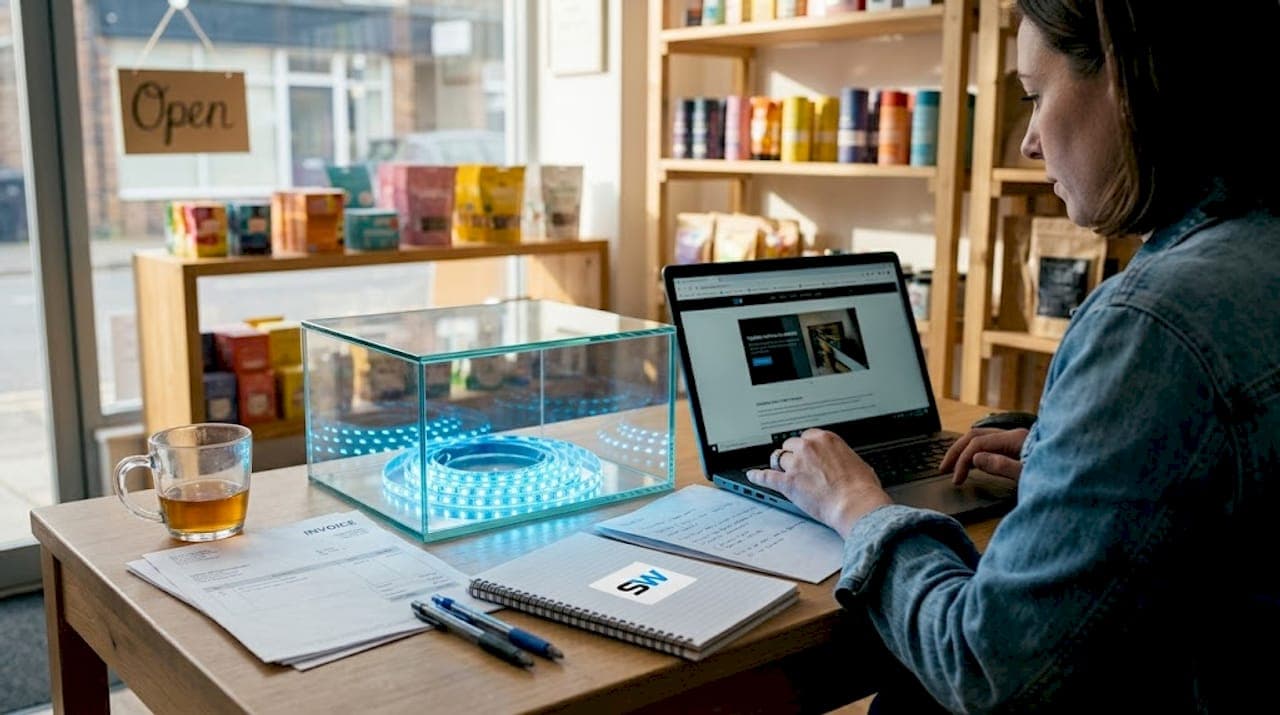
A single, outdated, slow-loading website can quietly drain thousands of dollars from your business every month. Restaurant owners, gym managers, and barbershop operators are all competing for the same local customers, and those customers are making split-second decisions online before they ever walk through your door. Professional web design is not a luxury; it is a direct growth lever. Case studies show that optimized restaurant sites achieved a 42% increase in bookings and 80% higher table occupancy. This article will show you exactly why that happens and how to apply the same thinking to your business.
Table of Contents
- The real impact of design on credibility and sales
- Page speed and user experience: The hidden sales multiplier
- Why DIY or 'cheap' web solutions often fail local businesses
- How to choose the right web designer for your local business
- What most guides miss about professional web design ROI
- Make your next step count: Investing in your online presence
- Frequently asked questions
Key Takeaways
| Point | Details |
|---|---|
| Design impacts credibility | Most customers decide to trust your business based on first impressions from your website. |
| Speed boosts sales | Fast, professionally optimized sites convert more visitors into bookings and purchases. |
| DIY risks higher bounce | Cheap and DIY web solutions can hurt rankings and reduce customer trust, costing sales. |
| Choosing experts matters | Partnering with the right web designer ensures your site delivers real ROI for your industry. |
The real impact of design on credibility and sales
Building on the introduction's data, let's examine why appearances matter so much online. When a potential customer lands on your website, you have roughly three seconds to make a strong first impression. If your site looks cluttered, loads poorly, or feels outdated, they are gone. And they are not coming back.
The numbers are clear. 94% of first impressions are design-related, and 75% of people judge a business's credibility based on its website alone. That means before a customer reads a single word about your Italian restaurant, your CrossFit gym, or your barbershop, the design of your site has already influenced their decision.
Here is how poor design actually damages your sales pipeline:
- Visitors bounce faster. A high bounce rate signals to search engines like Google that your site is not relevant or useful, which pushes your rankings down and makes you harder to find.
- Trust erodes immediately. Outdated fonts, broken layouts on mobile, and missing contact information all tell a visitor, "This business is not serious."
- Calls to action get ignored. If your "Book Now" or "Reserve a Table" button is buried or hard to find, customers will not click it. They will find a competitor who makes it easy.
- Repeat visits decline. A frustrating experience means customers are far less likely to return, even if they liked your food or service.
"Your website is often the first handshake with a new customer. If that handshake is weak, the deal is already done before you had a chance to speak." — A core principle behind every site I build at Stewart Web Design.
The financial stakes are concrete. Think about a barbershop booking 20 appointments per week through its website. If poor design causes even 30% of visitors to leave without booking, that is six lost clients every single week. At $35 per cut, that's $210 weekly and roughly $10,920 annually in missed revenue from design alone.
| Business type | Missed bookings per week (poor design) | Annual revenue lost (estimated) |
|---|---|---|
| Barbershop | 6 | $10,920 |
| Restaurant | 15 | $22,500 |
| Gym | 8 | $19,200 |
These are conservative estimates. The real number is often higher because poor design compounds; it affects your Google rankings too, which means fewer visitors even arrive in the first place. This is why designing for customer perception is at the core of every high-converting website I build, not just making things look pretty, but making them work.
Page speed and user experience: The hidden sales multiplier
Now that we've seen the importance of first impressions, let's look at what actually happens when users interact with your site. Speed is not a technical detail. It is a business-critical factor that directly controls how many of your visitors become paying customers.

Professional speed optimization has delivered remarkable results in real-world settings: restaurants saw a 42% jump in bookings and an 80% lift in table occupancy after their sites were rebuilt with performance in mind. And the inverse is equally proven. A single one-second delay in page load time cuts conversions by 7%. For a restaurant generating $5,000 per month through online reservations, that one second costs $350 monthly, or $4,200 per year.
What slows your site down?
- Uncompressed images. A gym homepage packed with high-resolution photos of equipment and classes can easily weigh 10 MB or more. A professional designer compresses and formats these images properly, often cutting load times in half without any visible quality loss.
- Bloated templates. Many DIY platforms load dozens of unused scripts and plugins in the background. Every one of those adds milliseconds of delay that stack up into seconds.
- Poor hosting. Cheap shared hosting means your website shares a server with hundreds of other sites. When those sites get traffic spikes, yours slows down too.
- No caching strategy. A professionally built site stores key elements in the visitor's browser so repeat visits load almost instantly. Template builders rarely set this up correctly.
- Non-minified code. Professional developers compress their HTML, CSS, and JavaScript files to reduce file size. This single step can shave 20 to 40% off loading times.
Pro Tip: Ask any web designer you're considering to show you a Google PageSpeed Insights score for one of their live client sites. A score above 90 on mobile is a clear indicator they know what they're doing.
Navigation is the other half of the user experience equation. A barbershop client needs to find your pricing, see your gallery, and book an appointment in under three clicks. A gym needs a prominent class schedule, a clear membership pricing page, and a frictionless sign-up flow. When navigation is intuitive, customers move forward. When it's confusing, they leave.
| Website element | DIY builder average | Professionally built site |
|---|---|---|
| Mobile load time | 4.2 seconds | 1.8 seconds |
| Google PageSpeed (mobile) | 45 to 60 | 88 to 97 |
| Bounce rate | 65% to 75% | 35% to 45% |
| Booking conversion rate | 1% to 2% | 4% to 7% |
These gaps are not minor. They represent the difference between a website that costs you money and one that earns it. A custom web design for speed ensures that your visitors get the fast, clean experience they expect, and that your conversions reflect that.
Why DIY or 'cheap' web solutions often fail local businesses
With user experience and speed understood, it's important to assess the alternatives many small businesses consider. The DIY website builder market is enormous, with platforms promising drag-and-drop simplicity and "professional results." For some very basic use cases, they deliver. But for local businesses competing for customers in 2026, they almost always fall short in the ways that matter most.
Here is why that is:
- Template credibility is generic. When your Italian restaurant uses the same template as 10,000 other businesses, there is nothing distinctive about your online presence. Customers notice, even if they cannot articulate why.
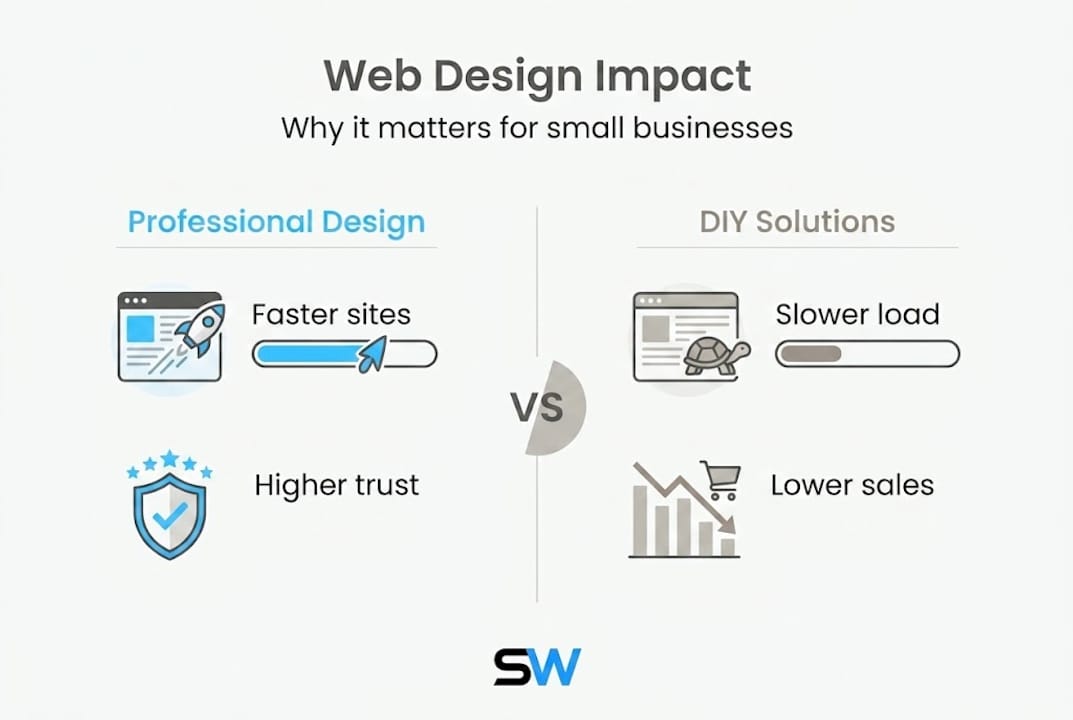
- Speed is not prioritized. DIY builders prioritize ease of use for the builder, not speed for the visitor. The result is sites that look fine on a desktop but load slowly on mobile, where most of your local customers are searching.
- SEO is handled poorly. Search engine optimization requires clean code, fast loading, proper heading structures, and optimized metadata. DIY platforms often generate messy code that search engines struggle to read, which hurts your ranking in local searches.
- Conversion features are locked behind paywalls. Many builders charge extra for booking integrations, reservation systems, and e-commerce. By the time you add the features your restaurant or gym actually needs, the "affordable" platform is not so affordable anymore.
- Support is non-existent when it matters. Template builder support is usually a help article database. When your site goes down on a Friday night and you have 80 reservations booked for Saturday, you need a real person who knows your site.
Since 94% of first impressions are design-related, a generic template puts you at an immediate disadvantage. Customers who visit your site and see a clearly templated layout subconsciously question whether your business is worth their money. That skepticism shows up in your booking numbers.
Pro Tip: Before committing to any website solution, search for your top three local competitors and evaluate their sites honestly. If their online presence looks more polished than yours, you are likely losing customers to them right now.
The "cheap now, expensive later" problem is real. A business that spends $200 on a template website and loses 10 new customers per month is spending far more than a business that invests $1,500 in a custom website for small business needs and converts those visitors into loyal regulars. The math almost always favors professional investment.
How to choose the right web designer for your local business
Having covered the pitfalls and advantages, let's discuss how to ensure you partner with the right design expert. Not all web designers are equal. Some specialize in corporate sites; others work exclusively with e-commerce stores. For a local barbershop, restaurant, or gym, you need someone who understands your market, your customers, and the specific features your business needs.
Here is a practical process for choosing the right partner:
- Review their portfolio for industry relevance. Ask to see sites they've built for businesses similar to yours. A gym website and a restaurant website have very different user journeys. A designer who has done both well understands that nuance. Look for clean layouts, clear calls to action, and functional booking or reservation integrations.
- Ask specifically about speed and mobile performance. Request PageSpeed Insights scores for their existing client sites. If they cannot provide this or seem unfamiliar with the question, move on. Speed is foundational to every measurable result you will get from your site.
- Clarify the conversion strategy. A website is not a brochure. It is a sales tool. Ask your prospective designer what specific steps they will take to turn visitors into customers. They should talk about button placement, call to action clarity, booking flow, and mobile layout strategy.
- Understand post-launch support. What happens if something breaks after your site goes live? How quickly will they respond? Do they offer revisions? For local businesses, downtime or errors on a website can mean real lost revenue in hours.
- Ask about launch timelines. If you need your site live quickly, ask what is realistic. Professional designers who work with small businesses can often launch a fully functional site much faster than you'd expect. I personally launch client sites within 24 hours of final approval.
Pro Tip: Insist on a clear conversation about measurable outcomes before signing any contract. A confident, experienced designer will welcome the conversation and point to specific case data showing results like 42% booking increases rather than vague promises about "improving your online presence."
One additional consideration: look for a designer who will communicate in plain language. You should never feel like you need a computer science degree to understand what is being built for your business. The best designers translate technical decisions into business outcomes, explaining why each choice matters for your growth, not just your code. Finding the right partner for web design solutions for local markets means finding someone who thinks like a business owner, not just a developer.
What most guides miss about professional web design ROI
Most articles on web design ROI focus on the immediate wins: more bookings, higher traffic, better Google rankings. Those results are real and worth pursuing. But there is a deeper layer that rarely gets discussed, and it is where the sustained competitive advantage actually lives.
The businesses I see winning long term are not the ones who launched a great website and stopped there. They are the ones who treat their website as a living asset that evolves with their business. When a gym adds a new class schedule, that update should be reflected online within hours, not weeks. When a barbershop brings on a new stylist with a strong local following, their profile should go live immediately to capture search interest.
Here is the uncomfortable truth about ROI that most guides skip: the first 30 days after launch are not your biggest opportunity. Your biggest opportunity is month six and month twelve, when your site's speed advantage compounds into search ranking gains, your returning visitor rate has grown, and customer referrals start arriving because your site made booking so effortless the first time that your clients told their friends about it.
The hidden benefits, loyalty, referrals, and brand differentiation, are worth more than any single booking lift. A professionally designed website communicates that you take your business seriously. And customers who sense that seriousness become the kind of regulars who leave five-star reviews and recommend you to every person they know. Web design, done right, is not a cost. It is the most scalable marketing tool a local business has.
Make your next step count: Investing in your online presence
You now have a clear picture of why design drives growth, what separates fast, high-converting sites from slow, generic ones, and what to look for in a professional partner. The next logical move is putting that knowledge to work.
I build custom websites for small business owners in food service, fitness, and personal grooming who are ready to stop losing customers to a weak online presence. Every site I create is fast, mobile-responsive, and built specifically around your business goals, whether that means a seamless reservation system for your restaurant, a slick booking flow for your gym, or a portfolio showcase for your barbershop. With launch timelines under 24 hours, unlimited revisions, and ongoing support, getting started is far easier than you think. Let's build something that actually grows your business.
Frequently asked questions
How does professional web design increase sales?
Professional web design optimizes speed and usability, leading to higher booking rates and improved customer trust. Speed-optimized sites have shown a 42% increase in bookings and an 80% lift in table occupancy in documented restaurant case studies.
Why is website credibility so important for small businesses?
Since 75% of people judge a business's credibility by its web design, your site's appearance directly controls whether visitors trust you enough to book, buy, or call.
Can a slow site really reduce conversions?
Yes, a one-second delay cuts conversion rates by 7% or more, which means every additional second your site takes to load is quietly costing your local business real money.
What makes professional web designers better than DIY solutions?
Professional designers deliver industry-tailored layouts, fast mobile performance, and strategic booking flows that generic DIY platforms cannot match. Because 94% of first impressions are design-related, the gap between a custom site and a template shows up directly in your conversion numbers.